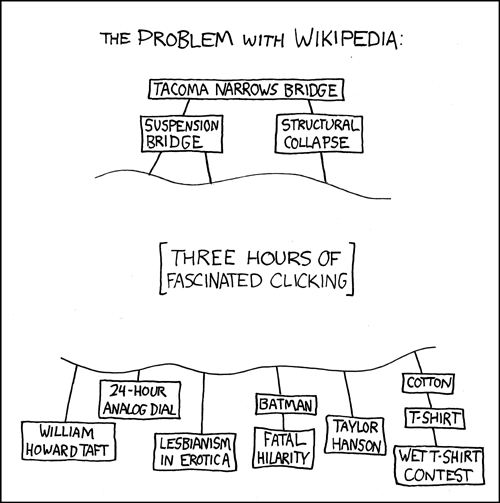
Wikipedia, the poor man's dictionary or all encompassing "know-it-all" on the web! Either way you look at it, there is a TON of information on that site. http://www.wikipedia.org. I have been tasked with using Wikipedia to explain Active and Passive voice, as it pertains to Wikipedia and everyone who has contributed to it.
First off, for those of you who have no idea what Wikipedia is (Where have you been?!), let me explain. It's a free, web-based, collaborative, multilingual encyclopedia project supported by the non-profit Wikipedia Foundation. It's a website where anyone from all over the world can post information pertaining to events, history, etc.
COOL PIC ABOUT WIKI
All you need to do is sign-up and WALL-LA! So now that we know what Wikipedia is lets continue on to the "Topic" at hand!
The following words defined by Wikipedia:
Active Voice: In grammar, the voice (also called diathesis) of a verb describes the relationship between the action (or state) that the verb expresses and the participants identified by its arguments (subject, object, etc.). When the subject is the agent or actor of the verb, the verb is in the active voice. When the subject is the patient, target or undergoer of the action, it is said to be in the passive voice.
For example, in the sentence:
The cat ate the mouse.
the verb "ate" is in the active voice, but in the sentence:
The mouse was eaten by the cat.
the verbal phrase "was eaten" is passive.
Passive Voice: In English, as in many other languages, the passive voice is a grammatical voice in which the subject receives the action of a transitive verb. Passive voice emphasizes the process rather than who is performing the action. Passive (or passive verb[1]) refers more generally to verbs using this construction and the passages in which they are used. In English, a passive verb is periphrastic; that is, it does not have a one-word form, but consists of an auxiliary verb plus the past participle of the transitive verb. The auxiliary verb usually is a form of the verb to be, but other auxiliary verbs, such as get, are sometimes used. The passive voice can be used in any number of tenses. The process of changing an active verb into a passive one is called passivization. Passivization is a valence-decreasing process, and it is sometimes referred to as a detranzitivizing process, because it changes transitive verbs intro intransitives.[2]
In the following passage from the Declaration of Independence, the passive verbs are bolded, while the active verb hold and the copulative verb are are italicized:
We hold these truths to be self-evident, that all men are created equal, that they are endowed by their Creator with certain unalienable Rights, that among these are Life, Liberty and the pursuit of Happiness.
One can still introduce the actor of a passive verb using a by phrase as was done in the example above. When such a phrase is missing, the construction is called an agentless passive. Agentless passives are sometimes preferred in official writing because they are less confrontational, for instance when announcing someone's firing. Agentless passives are also used in scientific writing, where they are intended to provide an objective description in terms of processes rather than people. Using an agentless passive, a scientist may write:
The mixture was heated to 300 °C.
without saying who actually did it, which is (or should be) irrelevant as far as the scientific process goes. This approach to scientific writing is not universally accepted, and some US organization, like the The Council of Biology Editors, have called for a more direct, active voice approach. Another entrenched use is the double passive construction used in American court reporting.[1]
The active voice is the dominant voice in English at large, and many commentators, notably George Orwell in his essay "Politics and the English Language" and Strunk & White in The Elements of Style, have urged that the use of the passive voice should be minimized. However, there is general agreement that the passive is useful when the receiver of the action is more important than the doer.[3]
In closing please note one thing, and that is that Wikipedia is free but also some of the information is not 100% accurate so please check the sources. Thank you!
References: http://en.wikipedia.org/wiki/What_is_wikipedia
http://en.wikipedia.org/wiki/Passive_Voice
http://en.wikipedia.org/wiki/Active_Voice


