A resume could possibly be the most important document you ever write in your life. This is why you must set it apart from all the other resumes that are out there. There are a few basic things that are a must for any resume.
One is it has to be appealing to the eye.If your resume is just another resume, then it’s just going to be lost in the pile of other resumes. You have to make the viewer notice your resume while keeping it professional. You can do this by adding borders or other things throughout your resume. However, while doing this make sure to keep your resume professional looking. If your resume has borders and pictures that make it hard to read or make it confusing the reader may not even give it a serious look and just throw it in the NO pile.
Here is a video that may be helpful in your resume writing:
1) There is NO perfect resume
2) You can have more the one resume
3) Have an objective
4) State what you did
5) Do research
6) Stay relevant
7) Be specific
8) Be organized and to the point
9) Don’t be a job hopper
10) Be yourself
Thursday, November 12, 2009

Monday, November 9, 2009
Ryan's 10 ways to attract traffic to your blog!
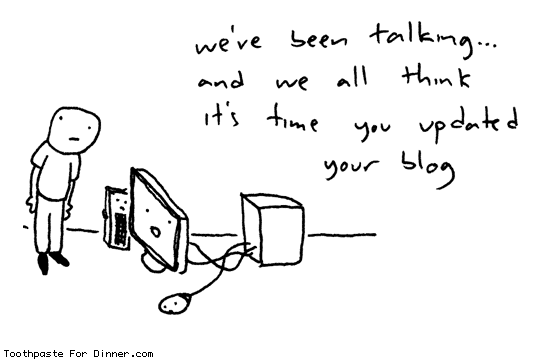
The Internet, an ever growing macrocosm of information, opinion, and knowledge. What is one way of getting these bits of information? Blogs! There are millions of people out there in the world contributing in one way to the great blogosphere, sharing their personal opinions, information and knowledge with the world.
Side Note; I didn’t even know there was such a word as blogosphere before writing this entry, but oh there is. Blogosphere; meaning made up of all blogs and their interconnections. http://en.wikipedia.org/wiki/Blogosphere
Continuing on…one important question one must ask themselves when writing a blog. Do I want other people to read this? We all would assume so, since after all, they are posting this on the web. So assuming, yes is the answer, I will offer up “10 ways to attract traffic to your blog!”
1. Update your blog regularly
If you are regularly updating your blog, it helps with your blogs search ability. It is recommended that you do so at least 3-5 times per week. That seems like a lot, I know.
2. Submit to blog directories
These would be google, yahoo, bloghearld.com, etc.
3. Create internal links
Post links to the thinks you are talking about. Be it a link to a hotel that you stayed at, if you’re writing about a vacation. You would be surprised to find out this can all aid you in finding readers for your blog.
4. Encourage commenting
Ask for feedback from your readers. Again another way to show hits to your blog, which in return helps your blog’s search ability on the web.
5. Leave comments on other blogs
Read and comment on others blogs as well as your own.
6. Self Promote
Tell people about your blog and where to go to read it, the address, name etc. You are your best spokesmen/women.
7. Be Original
Let’s be honest it’s going to be hard to gain readers if your writing about the same thing 1,000 other people are already writing about.
8. Insert Videos/Pictures etc.
This will help create dynamic content, which helps with the above suggestion of “Be Original”. We all like flashy things and what’s better than a Video/Picture to back up your writings?
9. Complain, Complain, Complain!
We all have heard or possible read about this blogger who got a free laptop, because he complained and wrote about “Microsoft and Vista!” http://laughingsquid.com/microsoft-sent-a-free-laptop-with-windows-vista/ Talk about free press and promotion!!!
10. Start a blog!
Umm, you can’t get noticed or attract traffic unless you write a blog! Duh!
Daniel R's What is a Twitter?

What is a Twitter? Twitter is a text-based communication over the Internet, which allows friends, family, celebrities, and businesses to stay in communication with each other. Twitter can be used through many different applications like computer, phone, and numerous different websites. When someone notes what he or she are doing, or what they need to say on tweeter it is called a “tweet”. Tweeter was originally used for friends to let other friends or family know what they are doing at the current moment. Many businesses are beginning to realize the advertising and marketing opportunities through twitter.
Truthfully I think twitter is a bit much when it comes to personal use, and letting everyone know what you are doing at every moment. There are many other reasons people use twitter instead of just updating their current status, like following their favorite celebrities, favorite players, or for specials through businesses. I think twitter can be used as a great business opportunity for all kinds of businesses out there. It helps the business stay in contact with recent customers and may help get new ones. I think twitter could help professional writers because it helps let the customer learn more about the company. Twitter can also be helpful if you use it to listen to what people want; and create something based of that. It also helps with the customer service because it is a “real time” communication. Twitter is now one of the highest-ranking websites, and I believe it will continue to grow.
Resources used:
http://www.nytimes.com/2009/05/07/technology/personaltech/07basics.html?_r=1&adxnnl=1&adxnnlx=1257796947-O6R57KPZjBEhlbQtRdV2CQ
Jessica T's Preparing an Effective Cover Letter
Preparing a Effective Cover Letter:
It addresses the specific job for which you are applying for and listing the most important qualifications that attract the employer. This should be used to set yourself apart from others and make you more qualified for the position. It also list interesting details about yourself. Remember that the employer skims over the cover letter before the interview so they have a idea about your experiences and qualifications.
The resume should be written before the cover letter. The cover letter should be three or four key details/points from your resume. They should be brief of about 350 words on how you meet the employers needs not a life story.
Introductory Paragraph:
-Should only be 3-5 sentences.
-Identify the specific job you are applying for. Also include a reference if applicable.
- Refer to the source of your information about the job.
- Brief summary of how you are qualified for the job.
Body Paragraph:
-Details about your qualifications for the job. Include facts, figures, and details about your qualifications.
- Each paragraph should be organized by qualification. (The first paragraph could be your work experience, 2nd could be about your education history, 3rd might be your community service or other activities).
- You can use bullets or numbers to help you emphasize your qualifications.
-Body or any paragraph can be longer than 6 lines or else the reader will become distracted or lost.
Concluding Paragraph:
-Ties in the other documents that may be added in with your application.
-Should include a opportunity for the employer to meet with the you.
-Include a salutation at the end of the letter. This should be directed to the hiring manager so its personal and shows you took the time to find out the hiring managers information.
Reference:
425-426 of the Technical Communication in the Twenty-First Century of the class textbook.
It addresses the specific job for which you are applying for and listing the most important qualifications that attract the employer. This should be used to set yourself apart from others and make you more qualified for the position. It also list interesting details about yourself. Remember that the employer skims over the cover letter before the interview so they have a idea about your experiences and qualifications.
The resume should be written before the cover letter. The cover letter should be three or four key details/points from your resume. They should be brief of about 350 words on how you meet the employers needs not a life story.
Introductory Paragraph:
-Should only be 3-5 sentences.
-Identify the specific job you are applying for. Also include a reference if applicable.
- Refer to the source of your information about the job.
- Brief summary of how you are qualified for the job.
Body Paragraph:
-Details about your qualifications for the job. Include facts, figures, and details about your qualifications.
- Each paragraph should be organized by qualification. (The first paragraph could be your work experience, 2nd could be about your education history, 3rd might be your community service or other activities).
- You can use bullets or numbers to help you emphasize your qualifications.
-Body or any paragraph can be longer than 6 lines or else the reader will become distracted or lost.
Concluding Paragraph:
-Ties in the other documents that may be added in with your application.
-Should include a opportunity for the employer to meet with the you.
-Include a salutation at the end of the letter. This should be directed to the hiring manager so its personal and shows you took the time to find out the hiring managers information.
Reference:
425-426 of the Technical Communication in the Twenty-First Century of the class textbook.
Jessica T's Preparing an Effective Resume
Preparing an Effective Resume
A resume is to serve as an conservative, accurate and relevant document that shows the highlights of your qualifications that you could bring to the job you are applying for. Resumes are listings of experiences and training that you have experienced. Resumes should be professional and the smallest error will show your non-detailed professionalism.
There are different types of resumes; chronological, skill, entry-level resumes but the basic elements of a resume are as follows:
Your resume SHOULD:
-Highlights the academic and work experiences that you may have that would qualify you for the job.
-Should be organized so it will be easy to read (most employers don’t spend a lot of time reading your resume for the first time) and will be eye-catching.
-Show your ability to write and demonstrate your RELEVANT skills and achievements.
-Should use action words.
Your resume should NOT:
-Be a detailed biography
-“Be a document for all occasions, all jobs and all employers.” (Preparing an effective resume).
Explanation of each category:
Your resume should be a standard format with your education background coming first, then experiences, activities and then skills and interests. A resume should be 8 ½” x 11” white or off-white paper. A resume should be different throughout the document by using different fonts and styles for the typeface, but not to different to where the employer, reading the resume, gets confused or distracted.
Your resume should be one page but don’t sacrifice information of work experience. If your resume is for a public interest employer then your experience and activities should be more than one page since you want to show your commitment is genuine.
Your heading should have your name, telephone number (work or home numbers also) & e-mail address at the top. You can also include your school or permanent address.
Education should include your most current institution followed by reverse chronological order. Each institution should include the month and year of graduation or expected graduation year. List honors that you have received and if they are not self-explainable, then describe the honor.
Experience should list your volunteer work, clinic experience and internships you have been a part of. These should also be in reverse chronological order with the most recent first. Each job listing should include the name of the employer, location of job, your job title and dates of employment. Do NOT leave time gaps between job listings.
References:
Page 409-423 of Technical communication in the twenty- First Century class textbook.
Preparing an Effective Resume http://www.law.georgetown.edu/graduate/PreparinganEffectiveResume.htm
A resume is to serve as an conservative, accurate and relevant document that shows the highlights of your qualifications that you could bring to the job you are applying for. Resumes are listings of experiences and training that you have experienced. Resumes should be professional and the smallest error will show your non-detailed professionalism.
There are different types of resumes; chronological, skill, entry-level resumes but the basic elements of a resume are as follows:
Your resume SHOULD:
-Highlights the academic and work experiences that you may have that would qualify you for the job.
-Should be organized so it will be easy to read (most employers don’t spend a lot of time reading your resume for the first time) and will be eye-catching.
-Show your ability to write and demonstrate your RELEVANT skills and achievements.
-Should use action words.
Your resume should NOT:
-Be a detailed biography
-“Be a document for all occasions, all jobs and all employers.” (Preparing an effective resume).
Explanation of each category:
Your resume should be a standard format with your education background coming first, then experiences, activities and then skills and interests. A resume should be 8 ½” x 11” white or off-white paper. A resume should be different throughout the document by using different fonts and styles for the typeface, but not to different to where the employer, reading the resume, gets confused or distracted.
Your resume should be one page but don’t sacrifice information of work experience. If your resume is for a public interest employer then your experience and activities should be more than one page since you want to show your commitment is genuine.
Your heading should have your name, telephone number (work or home numbers also) & e-mail address at the top. You can also include your school or permanent address.
Education should include your most current institution followed by reverse chronological order. Each institution should include the month and year of graduation or expected graduation year. List honors that you have received and if they are not self-explainable, then describe the honor.
Experience should list your volunteer work, clinic experience and internships you have been a part of. These should also be in reverse chronological order with the most recent first. Each job listing should include the name of the employer, location of job, your job title and dates of employment. Do NOT leave time gaps between job listings.
References:
Page 409-423 of Technical communication in the twenty- First Century class textbook.
Preparing an Effective Resume http://www.law.georgetown.edu/graduate/PreparinganEffectiveResume.htm
Takamasa Y's Preparing for a Job Search

Where are the jobs and how am I suppose to find them?
The only person that knows what you want, need and like in a job is you. Yeah you can ask for advice and support from family and friends, but only you can prepare and go on the job hunt. Here are a few steps to follow to finding and obtaining employment.
1. Find out what your career objective is and gather information from resources. Verify your interests, values, personal skills and abilities. When you are in the middle of an interview, you should be confident and "sell" yourself as the best person for the job. By gathering information, I mean getting a sense of what kind of jobs are available and what qualities each of them look for.
2. Update or create your resume, cover letter and if needed, reference letters. The resume is the first impression the employer has of you and will most likely use it during an interview. Along with a resume, there should be a cover letter. Cover letters are what may make you stand out from all the other applicants, you have the chance to catch the attention of the hiring manager. References are important. Employers have the resources to check with your previous employers and see how you are as a worker, so be honest. The following is a link to a YouTube video about resumes, cover letters and references: www.youtube.com/watch?v=1fMebeC6ecU.

3. Find out who is hiring and apply,apply,apply. Search and apply online through search engines, such as craigslist.com. You can also visit and apply directly with the company, this may give you a chance to meet the potential hiring manager. In this case, you will want to dress apropriately and in a way that will make you fit in with the industry you are applying to and showering does help.
3. Find out who is hiring and apply,apply,apply. Search and apply online through search engines, such as craigslist.com. You can also visit and apply directly with the company, this may give you a chance to meet the potential hiring manager. In this case, you will want to dress apropriately and in a way that will make you fit in with the industry you are applying to and showering does help.
4. Next comes the dreaded interview. I know I know, just thinking about sitting across from someone who will determine if you are good enough or not good enough for their company is intimidating. In order to prepare for the interview, go online to the companies website and research as much as you can. Not only will they ask you questions about your experiences and what you can bring to the table, they will most definitely ask you something like, " So what did you think about our website or what do you think about our products?" If you properly prepare you will know all the right answers.
5. Send a follow-up thank you letter 24 hours after your interview. This is your opportunity to show that you are interested in the job and the interviewer will most likely remember you when it comes time to hiring.
6. YES they called you back with an offer! What do you do now? Well....take the job if it is what you want, need and like, remember only you will know. You will most likely be ask to come back and fill out paperwork and discuss things such as salary and benefits. If everything goes well, you have yourself a job.
I hope that these steps were helpful. Stay confident, do not take a job rejection as a personal attack on you, keep your eyes on the goal and keep in mind that whatever you input, your results will definitely reflect that. GOOD LUCK!
References:http://jobsearch.about.com/od/referencesrecommendations/a/recommendation.htm
http://www.collegegrad.com/jobsearch/1-1.shtml
http://jobsearch.about.com/od/interviewsnetworking/a/intfollowup.htm
Sunday, November 8, 2009
Brandon C. Meet Our Team Members

Here at Penfessionals we like to let our customers know who exactly we are and who exactly is working to meet their needs. This is why we have put together a little bit of information so we can tell you about ourselves:
Name: Veronika Myers
Major: Accounting
YR: JuniorHometown: Czech Republic
Hobbies: Loves spending time with her Husband, her 2 year old daughter, and 3 month old son. Also likes to travel, read some interesting books, visit historical sites and art museums.
Name: Ryan Sheppard
Major: Marketing
Minor: Advertising
YR: Junior
Prior Schools: University of Illinois, Urbana - Champaign
Military Back Ground: Was in the United States Marine Corps Reserves from 1999-2003 (DID NOT go to Iraq/Afghanistan) Hobbies: Working out, Triathlons, History, Cooking, Friends/Family
Name: Jessica Taylor
Major: Marketing
Minor: Advertising
YR: Junior
Hobbies: Traveling, Beach, going out with friends, Animals
Name: Leah Krause
Hometown: Bradenton, FL
Major: Business Management
Minor: Chemistry
YR: Junior
Prior Schools: Manatee Community College
Hobbies: beach, wakeboarding and knee boarding, Muddin’, Swamp Buggy’s
Name: Brandon Collier – Goes by Drew
Hometown: Fort Meade, Fl.
Major: Business Management
YR: Junior
Prior Schools: Warner Southern College, Polk Community College
Hobbies: Hunting, Fishing, Four Wheeling, Skiing
Name: Daniel Ritter
Major: Business Management
Minor: Entrepreneurship
YR: Junior
Hobbies: Sports, Tennis, Import Cars (Acura RSX)
Name: Takamasa Joshua Yanai – Goes by Josh
Hometown: Seattle, Washington
Major: Computer Science
YR: 2nd year at FGCUHobbies/Interests: Lived in Colorado, Japan and California. Been married for 4 years and have a 23 month old son named Caleb. When there's time likes to spend it with his wife and kid.
Name: Veronika Myers
Major: Accounting
YR: JuniorHometown: Czech Republic
Hobbies: Loves spending time with her Husband, her 2 year old daughter, and 3 month old son. Also likes to travel, read some interesting books, visit historical sites and art museums.
Name: Ryan Sheppard
Major: Marketing
Minor: Advertising
YR: Junior
Prior Schools: University of Illinois, Urbana - Champaign
Military Back Ground: Was in the United States Marine Corps Reserves from 1999-2003 (DID NOT go to Iraq/Afghanistan) Hobbies: Working out, Triathlons, History, Cooking, Friends/Family
Name: Jessica Taylor
Major: Marketing
Minor: Advertising
YR: Junior
Hobbies: Traveling, Beach, going out with friends, Animals
Name: Leah Krause
Hometown: Bradenton, FL
Major: Business Management
Minor: Chemistry
YR: Junior
Prior Schools: Manatee Community College
Hobbies: beach, wakeboarding and knee boarding, Muddin’, Swamp Buggy’s
Name: Brandon Collier – Goes by Drew
Hometown: Fort Meade, Fl.
Major: Business Management
YR: Junior
Prior Schools: Warner Southern College, Polk Community College
Hobbies: Hunting, Fishing, Four Wheeling, Skiing
Name: Daniel Ritter
Major: Business Management
Minor: Entrepreneurship
YR: Junior
Hobbies: Sports, Tennis, Import Cars (Acura RSX)
Name: Takamasa Joshua Yanai – Goes by Josh
Hometown: Seattle, Washington
Major: Computer Science
YR: 2nd year at FGCUHobbies/Interests: Lived in Colorado, Japan and California. Been married for 4 years and have a 23 month old son named Caleb. When there's time likes to spend it with his wife and kid.
Subscribe to:
Posts (Atom)


